What we do
We work from Board and executive appointments through to the project, operational, functional and technical leaders who make businesses work. Different roles call for different searches. Our approach stays the same: understand what you need, search the market properly and give you a considered view of the people we find.
Board & Executive Search
Chair, Non-Executive Director, CEO, C-suite and senior leadership appointments.
At this level, experience and track record matter. So do judgement, leadership style and fit with the organisation.
For Board appointments, we consider the existing Board, the organisation’s direction and the capability or perspective that may be needed around the table.
For executive appointments, we look closely at what candidates have actually led, the scale and complexity involved, and the environments in which they have succeeded.
Many of the strongest candidates will not be actively looking. Our role is to find them, understand them and help both sides decide whether there is a genuine fit.
Project and Operations
General Managers, Project Directors, Project Managers, Operations Managers, site leaders and other roles close to delivery.
These appointments can have a direct impact on safety, production, cost, schedule, culture and performance.
We understand the difference between a good title and genuine delivery experience.
We look closely at what someone has personally led, the scale and complexity involved, the problems they have faced and what they actually delivered.
Our networks in these markets have been built over decades, across Australia and internationally.
Functional and Technical
Finance, people, commercial, engineering, technical, technology, asset, strategy and other specialist leadership and management roles.
These searches often require a more targeted approach.
The right person needs strong functional or technical capability, but also an understanding of the business and operating environment around them.
We combine sector knowledge with detailed market research to identify people whose experience fits both.
That often means looking beyond the obvious candidates and organisations.
Leadership Advisory
Succession planning, talent mapping, leadership assessment and team composition.
Not every leadership question starts with a vacancy. Sometimes the useful work happens earlier.
Who could succeed an important leader? What does the external market look like? How does an internal candidate compare? Where are the capability gaps in a team?
We help clients answer those questions with a clearer view of their people and the market around them.
Sometimes that leads to a search. Sometimes it confirms the right person is already there. Both are good outcomes.
Our job is reducing appointment risk
Every appointment involves judgement. A good search process helps make that judgement better informed. We consider four areas throughout a search. Each asks a different question about the appointment.
01. Market risk
Have we looked widely enough?
A search can easily become limited to people who are already visible, already known or already looking.
We try to look beyond that.
We map relevant organisations, approach people directly and consider candidates whose experience may translate from adjacent sectors or different career paths.
The aim is simple: understand the market before narrowing it.
02. Capability risk
Can they deliver what this particular role requires?
A strong CV is useful, but it does not tell the whole story.
We look at what someone has actually done, their personal contribution, the scale and complexity involved and how relevant that experience is to the role ahead.
Shortlisted candidates are assessed against the brief, with strengths, gaps and areas worth exploring further clearly identified.
The aim is a considered shortlist and not simply a collection of impressive CVs.
03. Leadership risk
How do they lead when circumstances become difficult?
Leadership is easier to assess when you look beyond someone’s successes.
We explore how candidates have dealt with setbacks, conflict, underperformance, change, difficult decisions and sustained pressure.
We then test what we hear through career history, assessment and referencing.
The aim is to understand not only what someone has achieved, but something about how they achieved it.
04. Acceptance risk
Is the opportunity genuinely right for the person?
People rarely make senior career decisions based on remuneration alone.
The role, leadership team, ownership, culture, location, family and future opportunity can all matter.
We stay close to those conversations throughout the process and give clients and open view of how the opportunity is being received.
The aim is to avoid surprises late in the search.
A broader search creates the opportunity for a broader shortlist.
We therefore try to build the market map widely from the beginning rather than relying only on people or organisations already known to us.
We also question requirements that may unnecessarily narrow the market without improving the appointment.
Every candidate still needs to demonstrate that they can do the job.
For us, broad access and careful assessment belong together.
Diversity is won or lost at the mapping stage

How a search runs
Three phases. Clear, thorough and practical.
Define
We start by understanding the role, the organisational culture and what success needs to look like.
We than test that against our experience and the market.
If something in the brief, remuneration or expectations may make the search unnecessarily difficult, we will raise it before going to market.
Together, we agree the position specification and the basis on which candidates will be assessed.
Secure
We research the market and approach relevant people directly, including those who may not be looking.
Candidates are assessed against the position specification and, where appropriate, our Leadership Compass.
Shortlisted candidates are presented with a clear view of their experience, strengths and areas worth exploring further.
Referencing is conducted personally by the principal leading the search.
Embed
For senior appointments, we remain connected after the person starts.
Structured conversations during the first twelve months provide an opportunity to discuss how the transition is progressing and raise issues early where useful.
If a placement leaves or is terminated for underperformance within twelve months, we conduct the search again at no professional fee.
TDN Leadership Compass
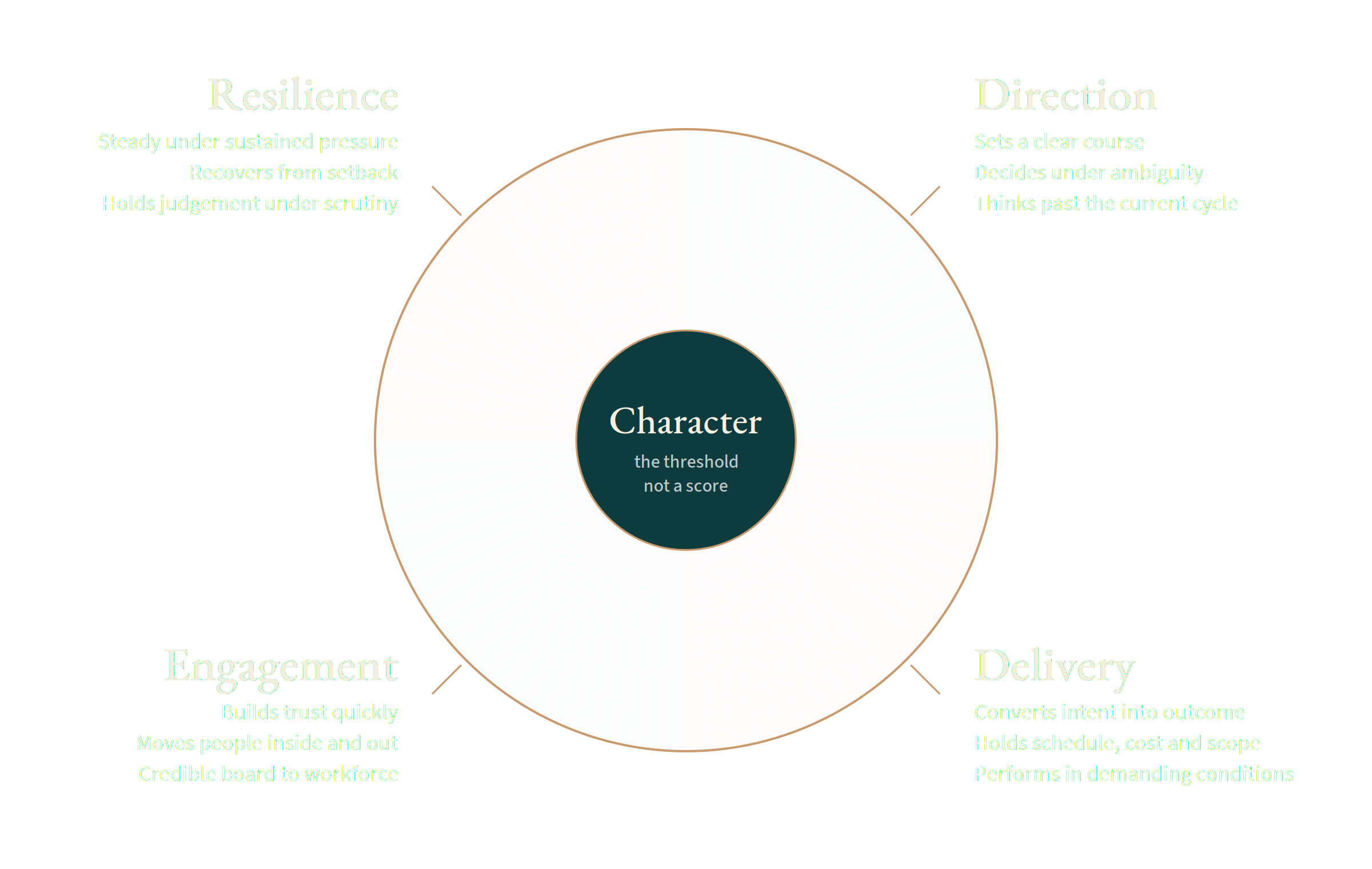
Four dimensions. Character underneath them all.
Why it exists
Leadership can be difficult to judge from a CV and interviews alone.
The Leadership Compass gives us a consistent way to explore four areas we believe are important: Direction, Delivery, Engagement and Resilience.
It is not intended to replace judgement. It helps structure it.
What you receive
For appropriate appointments, shortlisted candidates are assessed against the Compass.
Our assessment considers both strengths and areas that may require further exploration.
No candidate is perfect.
The value is in understanding as much as possible before making the appointment.
The four dimensions
Direction. How they think, make decisions and provide clarity about where the organisation or team needs to go.
Delivery. What they have delivered, how they contributed and whether they can turn plans into outcomes.
Engagement. How they lead people, build trust and work with teams, Boards and other stakeholders.
Resilience. How they respond when circumstances change, pressure increases or things do not go to plan.
Character
Character sits beneath all four. We regard integrity and character as fundamental. They are qualities we believe should be traded against strengths elsewhere.
The outcome isn't a shortlist.
A shortlist is part of the process, not the objective.
The objective is to give you a considered view of the market and the people within it, so you can make a better-informed appointment.
We do the research, ask the questions and give you our view.
The decision remains yours.